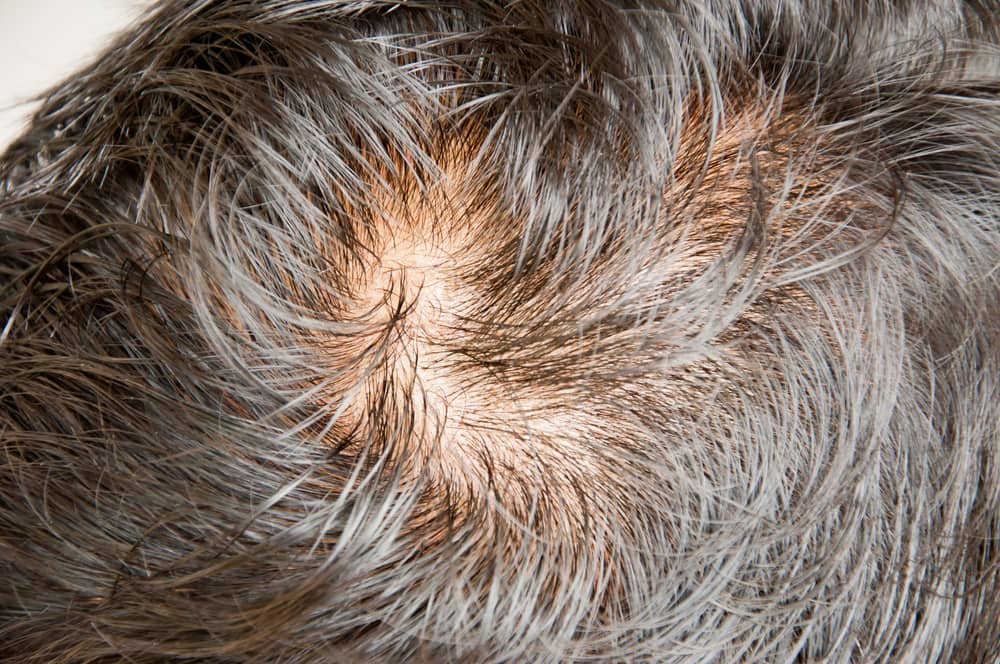

Alopecia, or baldness, is defined as the abnormal loss of hair, and, as highlighted by the Spanish Academy of Dermatology and Venereology (AEDV), there are more than one hundred different types. In this post, you can learn some details of the most relevant ones and also discover their most common treatments.
Before starting, you should keep in mind that controlled hair loss is a normal process. When we are children, we have between 100,000 and 150,000 hair follicles on the scalp, but we lose them over time. The density decreases, so that, if a healthy child has about 1,100 hair follicles per square centimeter, at the age of 25 they have about 600 left, which are reduced to only 250 between 30 and 50 years. This process is usually normal, so we speak of alopecia when hair loss goes beyond these figures, either temporarily or permanently.
The three most common types of alopecia:
Androgenetic alopecia
It is what is known as common baldness and is one of the most frequent, being able to affect up to 45% of men, and increasingly also women. In fact, it is estimated that between 12 and 20% of women aged 30 suffer from androgenic alopecia to a greater or lesser extent, a proportion that increases to 41% among those over 70 years.
It is due to a combination of genetic and hormonal factors, which lead to a decrease in the growth phase of the hair, a lower density of hair follicles on the scalp and a smaller diameter of the hair.
This is a chronic process which we can treat with different options to slow down its evolution and help maintain hair for as long as possible.
For cases in mild and moderate initial stages, there are food supplements based on plant extracts such as Serenoa repens, Cucurbita pepo or Pygeum africanum together with other ingredients necessary for hair formation.
Among the possible pharmacological treatments for androgenic alopecia, minoxidil has been used for many years, which is used topically, although it also has an oral formulation. Other medications that are applied directly to the scalp are finasteride, tretinoin, progesterone, spironolactone or canreone.
Finasteride, which is a drug initially developed to treat benign prostatic hyperplasia, which also proved to be useful for androgenic alopecia orally, although at a different dose for both indications. Another drug in the same family is dutasteride, which has been studied more recently to treat this form of baldness.
Other novel treatments are injected directly into the scalp, such as platelet-rich plasma with growth factors or dutasteride microinjections, which act by increasing hair density and strengthening existing hair. Alternatives such as low-power laser are also under development.
For more advanced stages, patients also have minimally invasive options, such as hair transplantation, especially the technique called FUE, consisting of extracting follicles from the occipital region and transplanting them to the most depopulated areas of the scalp. Of course, if you resort to this possibility, it is advisable to put yourself in the hands of qualified specialists and avoid low cost options.
Alopecia areata
This type of alopecia develops in the form of well-defined oval or circular areas of hair loss, as if they were patches, on the scalp and that, although it can take place at any age, it is more frequent in youth. Little is known about its causes, although there is talk of its possible origin due to stress, genetic predisposition or autoimmunity problems. The positive thing is that in alopecia areata the hair follicles are not destroyed, so the hair could grow back if the affected areas are few and small in size, although its possible solution is complicated when it affects a large part of the scalp.
Treatment is sometimes based on the use of corticosteroids that are injected under the skin, the topical application of minoxidil and, in the most severe cases, methotrexate combined with corticosteroids can be used, both orally.
Telogen effluvium
It is a transient hair loss caused by different reasons: changes of season, nutritional deficits, stress, postpartum, etc. It occurs when part of the hairs that are in the growth phase, called anagen phase, prematurely pass to the fall phase or telogen phase. Keep in mind that there is a natural renewal of the hair so that we lose about 100 hairs every day normally. Under normal conditions, around 10-15% of the total hair is in that telogen phase of fall.
When this % increases and more hair falls out than usual, we call it telogen effluvium. The positive thing about telogen effluvium is that it is a transient phenomenon and that after a few weeks your hair will have recovered. Sometimes, this sudden fall can be very distressing for those who experience it and it is advisable to take measures to stop it and promote a faster and more effective recovery. There are treatments based on nutritional supplements with different nutrients that can help you strengthen the growth of your hair and that the problem is solved more quickly.
It is also important to take care of the skin of the scalp, to promote an environment suitable for the proper development of the hair follicle. For this, there are some topical hair products, such as serums, preparations that moisturize and protect the scalp from chemical or thermal aggressions -dyes, dryers, irons etc
As we have already mentioned, there are many other types, although less frequent -traumatic, fibrosing, diffuse, scarring alopecia, etc.-, each with its characteristics, causes and treatments. The most important thing, and what you should keep in mind, is that each case is different and must be approached individually, so, if you think you may have a problem, put yourself in the hands of a dermatologist or qualified professional to find the diagnosis and find the best solution.
Bibliography
- Spanish Academy of Dermatology and Venereology. Alopecia in depth
https://aedv.es/wp-content/uploads/2015/04/alopecia.a_fondo.nov2009.doc - Juan Lemmel Montoya. Alopecia. Offarm, 2006;25(9):52-60
https://www.elsevier.es/es-revista-offarm-4-articulo-alopecia-13094153 - MSD Manual. Alopecia
https://www.msdmanuals.com/es-es/professional/trastornos-dermatol%C3%B3gicos/trastornos-del-cabello/alopecia